
Partly because the humidity makes it hard to inhabit my own skin, this summer was a tough one for me. It felt like I started to read a dozen different collections of short stories—but never finished one. I’ve written about Carleigh Baker’s Last Woman (2024) and the Russian stories in George Saunders’ A Swim in a Pond in the Rain), but weeks passed while I read from collections like they were magazines. At last, I finished a few.

Armstrong, Bo-Young, Grieco, Ha, Hernandez, Park and Rossi
Short Stories in July, August and September
Whether in a dedicated collection or a magazine, these stories capture a variety of reading moods.
This quarter, I returned to one favourite writer and also explored six new-to-me story writers.
The dozen stories in Maggie Armstrong’s Old Romantics (2025) read like a novel and fit like a new, sexy pair of panties that’s scrunching up in all the wrong places. It’s nearly hawt, and wholly recognisable.
Our heroine longs to be a writer but can’t create a lasting relationship even with her own work. She “slashed away each morning, with a cramping finger grip. I could do eight foolscap pages at a sitting, staple them together, but could never bear to look at them again.”
Almost as readily dispensed with is the series of men with whom she collides. All “pressing me close to him, and my legs seemed to come loose. Only he existed now. The long way home, the next morning, no need for any of it anymore.”
She perfectly captures that space between wisdom and naivete, as someone caught in the whirl of becoming. She is moving towards understanding and communion, luxury and climax—“She wore him wrapped around her like a big fur coat and he protected her from everything that had been bad.”—but crashing into reality instead, everything from bills to an unplanned pregnancy.
She doesn’t quite connect with the job market either, both “My Success” and “My Mistake” feel more ironic than their titles suggest. But her capacity to snortle at herself kept me coming back: “Her desire to have actual intercourse with a fictitious character must remain a secret.” And the thread of earnest uncertainty: “Did I need to find a means of escape, or would I somehow get used to it all, make a home of it—is that what growing up… amounts to?”
Like Susie Taylor, Shashi Bhat, and Deborah Willis, Maggie Armstrong makes her short fiction so ordinary it’s painful, so painful it’s tender, with such tenderness that it’s bearable.
Contents: Number One, The Dublin Marriage, All the Boys, Old Romantics, My Success, Sparkle, Baked Alaska, Trouble, Maternity Benefit, My Mistake, Two Nice People, Trouble Again


I started Kim Bo-Young’s I’m Waiting for You and Other Stories (2021) Trans. Sophie Bowman and Sung Ryu so many times it became something of a joke around the house. The book shifted position through nearly every room because the first story was so long—and I feared that it would end badly—that I must have restarted a dozen times.
The thing is, it’s a terrific premise, this title story. A young couple has plans to marry in the future, and they have different reasons for being in different places in the universe in advance of their wedding—which means they are in different times, too, given the complexities of space travel. I knew, just from leafing through the collection, that the story ends with a handwritten sticky note. Of course, I couldn’t know what time that note stemmed to, and even the first few segments of the story unfold in a variety of timelines…but I was anxious for this couple and I both wanted to know and didn’t want to know how things turned out for them.
The table of contents is curious, too, in ways that verge on spoiling, and I was unsure about the meaning of “and Other Stories” but I finally grew annoyed with my own reticence and sat down with it, determined to get to the end of the first story in that evening and, then, I was done the whole book in two days. (No TOC for this one: no spoilers!)
Don’t let the space travel deter you, if you enjoy narratives that play with time but are fundamentally rooted in emotion (and the overarching emotion is longing), settle in with this unexpectedly charming volume of…Story.
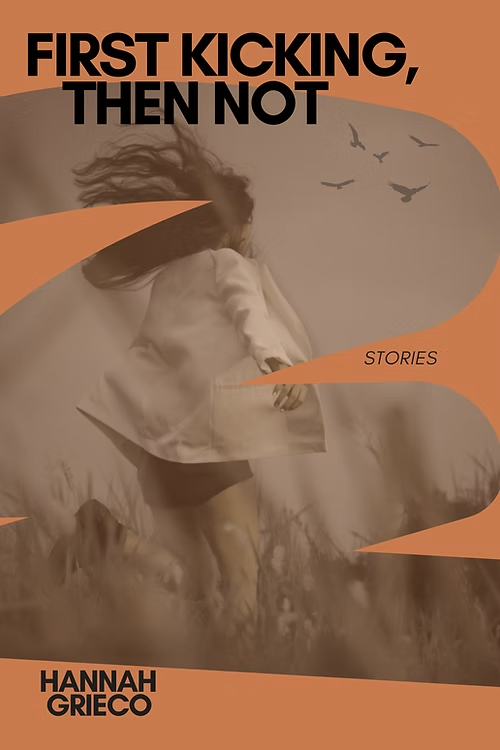
When I think about the kind of story that I want to read when I am on a bus and don’t want to be going where I’m headed? It’s the kind of story that Hannah Grieco writes in First Kicking, Then Not (2025) that I want to read. The kind of story for which the word punchy was reclaimed by critics.
In some ways, they are slight: there is often no real event that unfolds, sometimes no external view of characters whose perspective is the whole story. In other ways, they are overstuffed: with detail (the chicken place on 12th Street, or a jog down 3rd Avenue to Bowery to St. James to the bridge) and dialogue (texts and irritated inner-thoughts in italics, The Rock on a road trip).
Even if the economic downturn translates into my not being able to renew my Stanchion subscription, my elbows will still be up while I reread this startlingly weird and personable collection.
Contents: Fifteen stories in barely a hundred pages, from the title story to Nina Parker Chooses Nymphomania

The title piece in Khanh Ha’s new collection, The Eunuch’s Daughter (2024), is just over a hundred pages long; it’s a retelling of his novel Her: The Flame Tree (which I thought I’d written about here, but seemingly it’s the only one missing).
In this version, particularly with the inclusion of a couple illustrations, the story reads more like a fable than I remember from my reading of the novel in 2023. There are just five other stories in this collection, which have been previously published in literary journals and anthologies (he’s been nominated for the Pushcart Prize ten times).
Throughout, the themes that characterise his work are pronounced; they reverberate so steadily, that it almost feels as though the stories are linked.
Absence and loss, compassion and longing: Khanh Ha’s stories are sometimes painful, often poignant, and they conclude with a characteristic bittersweetness. Which I happen to find very satisfying.
“Their letters took a few months to come and go. She almost cut into the first letter she received from home when she hastily scissored the envelope. A sheet of yellowed paper bore her mother’s writing, the ink smeared on each downward-slanted line. The letter had no date. It took a while for her to recognize her mother’s voice in the handwriting. Her mother had written the letter over several days and left gaps between her thoughts, always preceded by the link, ‘I’ll come back later.’”
Contents: The Eunuch’s Daughter, A Yellow Rose for the Sinner, The Yin World of Love, The Weaver of Điên Biên Phủ, Destination Unknown, Two Shores
Mel recommended the Uruguayan writer Felisberto Hernandez’s Piano Stories (1993; Trans. Luis Harss, 2014) to me and, at the time, I was thinking of writers like Nancy Hale that he and I have enjoyed together, but Mel had also recommended Clarice Lispector to me, and although alphabetically this author would be shelved closer to Hale, these stories are more Lispector-y.
This collection opens with “How Not to Explain My Stories”, which suggests that explanations are frequently sought. He says: “My only certainty is that I can’t say how I write my stories, because each of them has a strange life of its own.” And that’s how it feels: that feeling unites the collection. But the language is simple and there are scenes which feel very ordinary; there is a sense of dark forces at work, but there is also an undercurrent of whimsy.
I think the sense that beckoned me back to the collection, which I read over several months, one story every couple of weeks, was something like nostalgia—a longing for…I’m not sure what. This is a long quotation, the opening of “The Balcony” but it captures the twinned simplicity and complexity—and it includes a cat.
“I liked to visit this town in summer. A certain neighborhood emptied at that time of the year when almost everyone left for a nearby resort. One of the empty houses was very old; it had been turned into a hotel, and as soon as summer came it looked sad and started to lose its best families, until only the servants remained. If I had hidden behind it and let out a shout, the moss would have swallowed it up.
The theater where I was giving my concerts was also half empty and invaded by silence: I could see it growing on the big black top of the piano. The silence liked to listen to the music, slowly taking it in and thinking it over before venturing an opinion. But once it felt at home it took part in the music. Then it was like a cat with a long black tail slipping in between the notes, leaving them full of intentions.”
Contents: How Not to Explain My Stories, Just Before Falling Asleep, The Stray Horse, No One Had Lit a Lamp, the Balcony, The Usher, Except Julia, The Woman Who Looked Like Me, My First Concert, The Dark Dining Room, The Green Heart, ‘Lovebird’ Furniture, The Two Stories, The Daisy Dolls, The Flooded House


David Park landed in my stack because of Susan’s consistent admiration; Gods & Angels (2016) was the perfect introduction for me. It was non-renewable interlibrary loan, so I was compelled to read them fairly quickly; the way I feel about his stories suggests I will love his novels too. (Which one, Susan? Do tell. Anyone else?)
His view of how people connect (and don’t), the capacity for a routine decision to profoundly and enduringly alter one’s course, the significance of a detail easily overlooked: so many elements coalesce.
But what elevates these stories, for me, is the balance he strikes with their endings. He invisibly constructs an emotional truth throughout the story, so that, when it is over, there’s a simultaneous blow of reality tinged with sentimentality that lands with unexpected power. I really love a good ending. The kind that makes you want to turn back to the beginning, so you can try to see how it was so skillfully knit together the whole time.
His final sentences evoke both a sliver of surprise (one aspect of that truth clearly stated) and a sense of inevitability (an authoritative observation from the storyteller that suggests this resolution—usually some kind of understanding or acceptance—was the only possibility).
“My path mostly crossed with that of my new acquaintances on Sunday mornings, but one late Friday afternoon after spending an hour in the pool pretending to myself that I was finally about to take my foot off the bottom, and then not wanting to try and conjure a miracle from the barren waste of my fridge, I decided to eat in the hotel bar.”
Swimming Lessons
Thanks to the Algorithm for recommending Cristina Peri Rossi’s collection of short stories (in translation by Robert S. Rudder and Gloria Arjona in 2014) Afternoon of the Dinosaur. This Uruguayan writer and translator has lived in Spain since she was exiled in 1972. Quite a few of her books have been translated into English over the decades, often by university presses: available, but not abundantly. Here, the introduction is by Julio Cortazar.
These stories are beautiful and strange. Not like Lispector’s, which remain inscrutable on rereading (for me): when I reread, there’s a space for me to contemplate, a sense of slow unravelling. Even the shortest stories are political, even when they’re not: “Each hive has only one fertile female, the queen, and around her the life of the colony turns.” The longest, the title story, too: “Because there had been a war—just a little war, not a big international war, a local war, an internal one, a war inside the country’s borders, but a war just the same.”
The narrowing field of focus in those quoted statements recalls other stories which feature mirrors and other glass structures: clarity, simulacrum (two stories titled such are science-fiction), reflection and refraction. And there’s also a thread of humour in the darkness: “Turning into an orphan only gets to be interesting after you’re eighteen.”
Contents: From Brother to Sister; At the Beach; The Influence of Edgar A. Poe on the Poetry of Raimundo Arias; Simulacrum; Afternoon of the Dinosaur; Queen’s Gambit; The Story of Prince Igor; Simulacrum II

Soon I will write about two Canadian collections, Timothy Findley’s Stones (1988) and Budge Wilson’s The Leaving (1990), which I started reading late-spring, but didn’t expect would remain in my stack for weeks. And in November, I will resume with Margaret Atwood’s stories in Old Babes in the Woods (which was expected—I’ve been reading a few each November since it was published).
Because I have been dawdling, I actually feel as though I’ve read more stories this year than usual, but the data says it’s actually fewer. I wonder, what will the autumn quarterly look like.
Is there a new (or new-to-you) collection you would recommend?
I’m really intrigued by Afternoon of the Dinosaur, but I’m a little sad it’s not a grand epic story about dinosaurs instead of a short story collection, lol.
Heheh Actually, I’d expected a little more dinasaur action myself! I think you’d like I’ll Be Waiting for You actually. I’ve “discovered” a new horror writer this season you would enjoy too…will share more soon!
David Park sounds particularly interesting to me, though the title and cover on their own would probably not attract me. Actually, I’m not sure this makes sense. I think the cover is beautiful but it looks like the cover of a book I wouldn’t read! You don’t really talk about the what sort of stories they are? Hmmm … but I love your discussion of their endings.
Actually, same. The title seems too …elevated? pretentious? and the cover too …staid? …unremarkable? for my taste. And I didn’t mention th4 contents because there is such a wide variety of premises and characters that it felt misleading when I drew attention to just a couple of them. I definitely had my favourites but I actually enjoyed the way he handles the endings even when I wasn’t particularly fond of a certain situation, so for me that really stands out. It’s unusual, I think, to be super disappointed with an ending (I can think of a few books straight off). But I also think it’s uncommon to be thrilled with an ending. A lot of suitable, or serviceab le, or meh.
So appreciate the diversity and range within these stories, thank you for sharing! Old Romantics in particular piqued my interest – I do love interpersonal mess – so I’ve added it to my to-read list. I read I’m Waiting for You and Other Stories a few years ago and gave it three stars. Hope you’re well and yay reading!
I think you might appreciate the way she maneuvers; it feels realistic in the sense that no matter how much she aims to be deliberate and mature, things that need saying go unsaid and decisions aren’t made so much as they happen. But, I would be a little surprised if you loved it?
I’ve had Old Romantics on my shelf for awhile and still haven’t gotten around to it, but your description makes it sound like I could enjoy it? Sort of a sexy read? For some reason, every time I see fruit on the cover of a book I assume it’s going to be sexy, and I’m not sure what that says about me LOL
Or what it says about fruit! heheh Yeah, even though I can’t remember the last time I said you’d like a collection of stories, I actually really think you would like these! And I think it would make a great bookclub pick, but not for the usual reasons one says that (when it comes to marketing) but because there is so much about relationships and not black-or-white: it would be fun to discuss over drinks and debate the decisions she makes. (
David Park has been on my list of writers to try for quite a while, so I’m grateful for your recommendation of Gods & Angels. It does sound like the type of collection I would enjoy. And the titular story in the Kim Bo-Young sounds very intriguing, too. As you say, it’s a tantalising premise – I’ve made a note!
I’m sure he’ll be much easier for you to find, and I’m sure you’ll enjoy them as much as I did. The novel that Susan recommends here in the comments is newer (2023, I think?) and also sounds very good.
The first two collections you reviewed sounded like the stories belonged together when not belonging together is what mostly puts me off short story collections. But the clincher was SF (and a country I’ve hardly been to reading-wise) so I’ve bought I’m Waiting for You. When will I get to it? that’s the question.
I can’t say why without spoiling, but I don’t think it will annoy you in the same way that many collections annoy you. It did remind me of another book we both read from an earlier UKLG year (even naming it would be a little spoilery).
I saw I’m Waiting for You in my Audible library last time I selected a new read, and wondered idly what (who) led me to buy it. Hopefully I’ll get to it in a few days time.
I wonder what it will be like as a “listen”, whether they will have two readers for the letter-writers (and whether you’ll find the letters believable or contrived).
I’ve a copy of Old Romantics and am looking forward to it. So pleased you enjoyed the Park. I was very impressed by Spies in Canaan although anything by him is worth reading.
Thank you! I’ll aim for that one, but will be glad to find whatever I cam in the meantime.
The Eunuch’s Daughter sounds very appealing. I have a few short story collections piled up which I wanted to get to for Lisa’s event last month, but life took over! I’m hoping to get to them soon and you’re very encouraging in reminding me how powerful collections can be.
If it’s any consolation, I feel as though it took me many years to get into a rhythm wherein stories naturally fit into my stacks. It felt like a very long time of “trying”.