
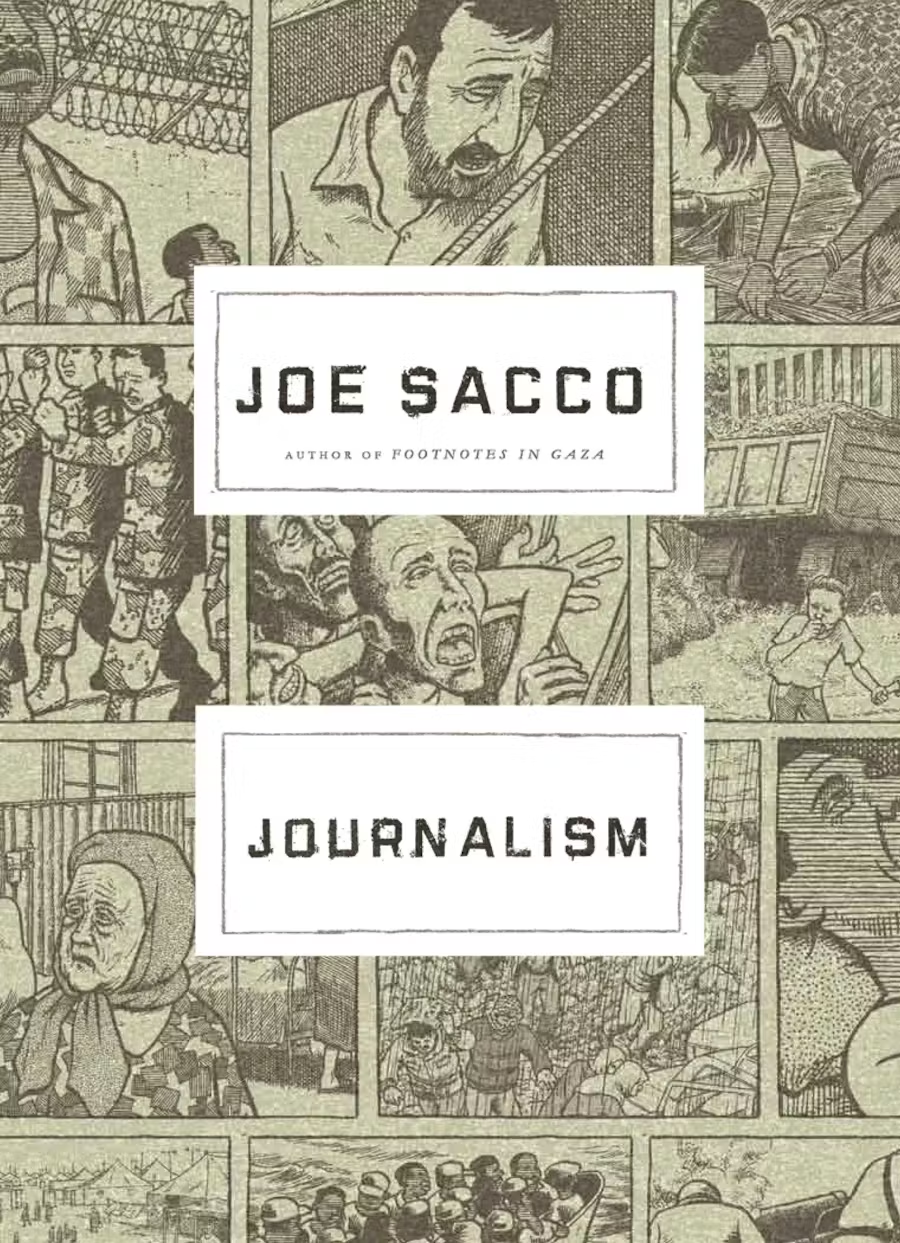
Joe Sacco’s Journalism (2012) is a longtime resident of my TBR; I was reminded of it because of his Footnotes in Gaza and Palestine. This, however, is a fabulous introduction to his work, divided into six sections: The Hague, The Palestinian Territories, The Caucasus, Iraq, Migration, and India.
Most of the comics are in panels, but there are a few broader and double-spread illustrations that almost feel like a Where’s Waldo level-of-activity. Even if you are the sort of reader who is so preoccupied by text that you usually miss the illustrations in graphic novels or graphic memoirs, these drawings by Sacco will arrest your attention with their detailed and intricate line work. (Even the smaller panels will be more likely to hold your attention, because there is very little unused space in them: it feels like everything is RIGHT THERE.)
After each section, a page describes how the work was originally presented and whether it was the result of a satisfying or frustrating contract with that newspaper’s/magazine’s editorial team. With the Palestinian piece, there is another comic, a double-spread of panelled work, which explores the same situation from a slightly different angle (prepared for a different assignment). So there’s some insight into the working journalist’s life (though drawing, not writing).
The preface to all this raises some excellent points about how reporters balance subjectivity/bias and seek balance/objectivity. Sacco doesn’t take the easy route. He quotes American journalist Edward R. Murrow to remind us that “Everyone is a prisoner of his own experiences. No one can eliminate prejudices—just recognize them.” And he warns against the myth of balanced reporting, saying that a journalist must “explore and consider” different “versions of events” but ultimately “get to the bottom of a contested account independently of those making their claims.
This was the perfect connection to Timothy Snyder’s The Road to Unfreedom (2018) which I was inspired to read after Emma wrote about her experience reading his On Freedom (2024). Prior to that, I had only read some of his essays/articles, but even there I admired his clarity and authority, his capacity to explain complex matters in the simplest of terms.
The Road to Unfreedom was published between the 2014 and 2022 Russian invasions of Ukraine; it was published during the 45th presidency of the United States, before he was re-elected as the 47th. Any thought I might have had, as to whether this work would remain relevant was quickly dismissed. Passages like this seemed to answer questions that I didn’t know how to articulate:
“Running for President in 2012, Putin rejected the idea of a European Russia, which meant ignoring external incentives that favored the rule of law. Instead. Proizvol would be presented as redemptive patriotism. The operative concept in the Russian language today is bespredel, boundary-less-ness, the absence of limits, the ability of a leader to do anything. The word itself arose from criminal jargon.”

It’s a little more than a decade ago, but it feels like it’s pulled from commentary about 2025 in the United States. And this passage, which reminds us that Ukrainians always knew and Americans, even still, a decade later, do not. Just this morning, I heard a reporter speaking about how 47’s pleas to Putin, to cease Russian attacks during the “peace talks”, with confusion in their voice, unsure why the Russians weren’t taking American peace-making seriously.
“The most remarkable element of Russia’s 2014 invasion of Ukraine was the information war designed to undermine factuality while insisting on innocence. It, too, continued in the United States, with greater sophistication and more impressive results than in Ukraine. Ukraine lost the information war to Russia in the sense that others did not understand Ukraine’s predicament. In general, Ukrainian citizens did. The same cannot be said of Americans.”
And, above all, why all this matters: “If we see history as it is, we see our places in it, what we might change, and how we might do better. We halt our thoughtless journey from inevitability to eternity, and exit the road to unfreedom. We begin a politics of responsibility.”
A politics of responsibility: what a concept. Hunting around for a worthwhile read to set the tone for your 2026-reading? Sacco and Snyder will not disappoint.
Oh my, both these books sound excellent though I don’t think I’d have the patience with Sacco’s detailed drawings as you describe them. I like my graphic books to be spare! But, I do like his warning against the myth of balanced reporting, when it implies both-sides-ism. It is a problem we have now with our national broadcaster, the ABC. Maybe you have it with the CBC? They are “expected” to be balanced which is interpreted as meaning presenting both sides evenly. I think it is important to hear the different sides but I want the journalists to analyse or critique the arguments or viewpoints, and I want them to be allowed to be brave in confronting uncomfortable questions. The politicisation of “sides” seems to be becoming more extreme, or, am I just getting older!
As for Snyder, wow, the “politics of responsibility”. Who would have thought! (The recent discourse in Australia about the Bondi attacks – I’m presuming you know what I’m talking about – has shown just how far removed we are from this idea.)
That’s interesting: I can think of some spare graphic novel/narratives and I see that appeal. I’m not sure I’m typical in reading these, as I tend to read all the words in a spread, then go back and look at all the pictures, and then sometimes I return again with my attention split between. But I think one ideally is intended to absorb both as one progresses? And I know MrBIP does read them like that, but I switch tracks.
Hmmmmm, our CBC used to maintain a pretense of balance. They would do a whole piece on a controversial issue from a generally liberal perspective and, at the very end, say a sentence (sometimes literally one sentence) to represent the more conservative view. Now they consistently represent the liberal-minded view, but although I usually share the opinions expressed, it’s often only opinion rather than reportage. There are many who would disagree with this, and, hey, Anne, if you’re reading this comment, I’m definitely NOT talking about your books spotlights. hee hee
Yes. Indeed. I’m sure you would appreciate Snyder, or maybe not you yourself, but others you know. Despite the tendency of many American journalists, his foundation is truly global (although in his newspaper writing of course he does focus more on questions of specific interest to Americans).
Snyder’s so good isn’t he? We went to see him when he showed up at the Appel Salon. The only problem with On Freedom was I’d heard him make most of his arguments in person before I read the book. It’s been a while since I read The Road to Unfreedom, but I remember being impressed at the time.
Stunningly. I’m so impressed. My hold on one of his earlier ones has just come in, and it had seemed it never would, so I think a few other people must have suspended their serious-reading over the holidays, which is nice for me. (They must have been attending the same extravaganzas you attended!) I purchased On Freedom as a gift for my father, so I’m glad to hear it works as an introduction to his basic tenets.
I love political cartoons (I love Archie comics and Calvin & Hobbes), but as with graphic novels, I wouldn’t have the concentration to follow a story told in panels of detailed pictures.
I get it; I have to read through the text and then backtrack and look at the illustrations before I turn the page…it’s a lot to take in all at once and I can’t NOT read the words.
Hi,
This book by Timothy Snyder seems as fascinating as the one I read. Thanks for the mention.
Thanks, Emma. I think I would enjoy all his books, I just haven’t gotten to them all yet.
Although we’d like to think of journalists as being unbiased, it is of course impossible, as they point out. However, I think folks who have gone to journalism school are at least made aware of their bias, whereas so many ‘news’ sources today don’t even try to hide, or avoid their bias. In fact, it’s their bias that seems to attract and grow their readership. Sigh.
Anne, I hope you don’t mind if I reply to your comment. My politics are seriously left wing and so I look out for analysis from that point of view. What seriously annoys me is news sources which insist on providing both sides of an argument even when one side – eg climate denialism, or vaccine denialism – is demonstrably false.
Sometimes it’s hard to spot the line, depending on one’s usual sources of news/information, between both-sides-ism and someone striving to include a variety of opinions/experiences/feelings (easier, as you say, with the types of “reporting” in which evidentiary denial is in play). I really love a double-spread with each journalist having a go at a topic, different takes but not necessarily oppositional, reminding us as readers that persuasion can be powerful, even when we don’t recognise it.
Of course! Please feel free to reply to any of my comments, this is what makes blogging and commenting so fun 🙂 And I totally agree with you – there’s a line between offering both sides of the story, and simply incorrect denial of proven science (i.e. vaccines, climate change). The whole ‘alternative fact’ trend from a few years ago gave rise to this unfortunate new form of journalism. I like to think that most professional journalists do understand the importance of fact checking…
What we think of as news and what we call news seems to have changed quite a bit in recent years, and we don’t talk enough about bias. How can we expect our kids to learn to think critically and to engage with information to find their footing and have an informed opinion, when so many of us are getting our “news” from social media shares (in an echo chamber of our own making)? I’ve reread his definition a dozen times and would like to commit it to memory! heheh