
Earlier this month—with Indigenous History Month in mind—I wrote about Thomas King’s latest Thumps Dreadfulwater mysteries, and my theme of Indigenous reading for this year’s Toronto Public Library Reading Challenge, including seven books by Indigenous writers that align with challenge themes.
Now, on the other side of Indigenous Peoples’ Day (June 21st), I’m sharing three works of fiction (including a middle-grade novel), a book of poetry, and two works of non-fiction. These are the work of Nêhiyaw/Cree, nêhiyaw âpihtawikosisân/Cree-Métis-European, Métis-Irish, Métis, Muscogee Creek, and Te Ātiawa-Ngāti Tūwharetoa-W̱SÁNEĆ writers.
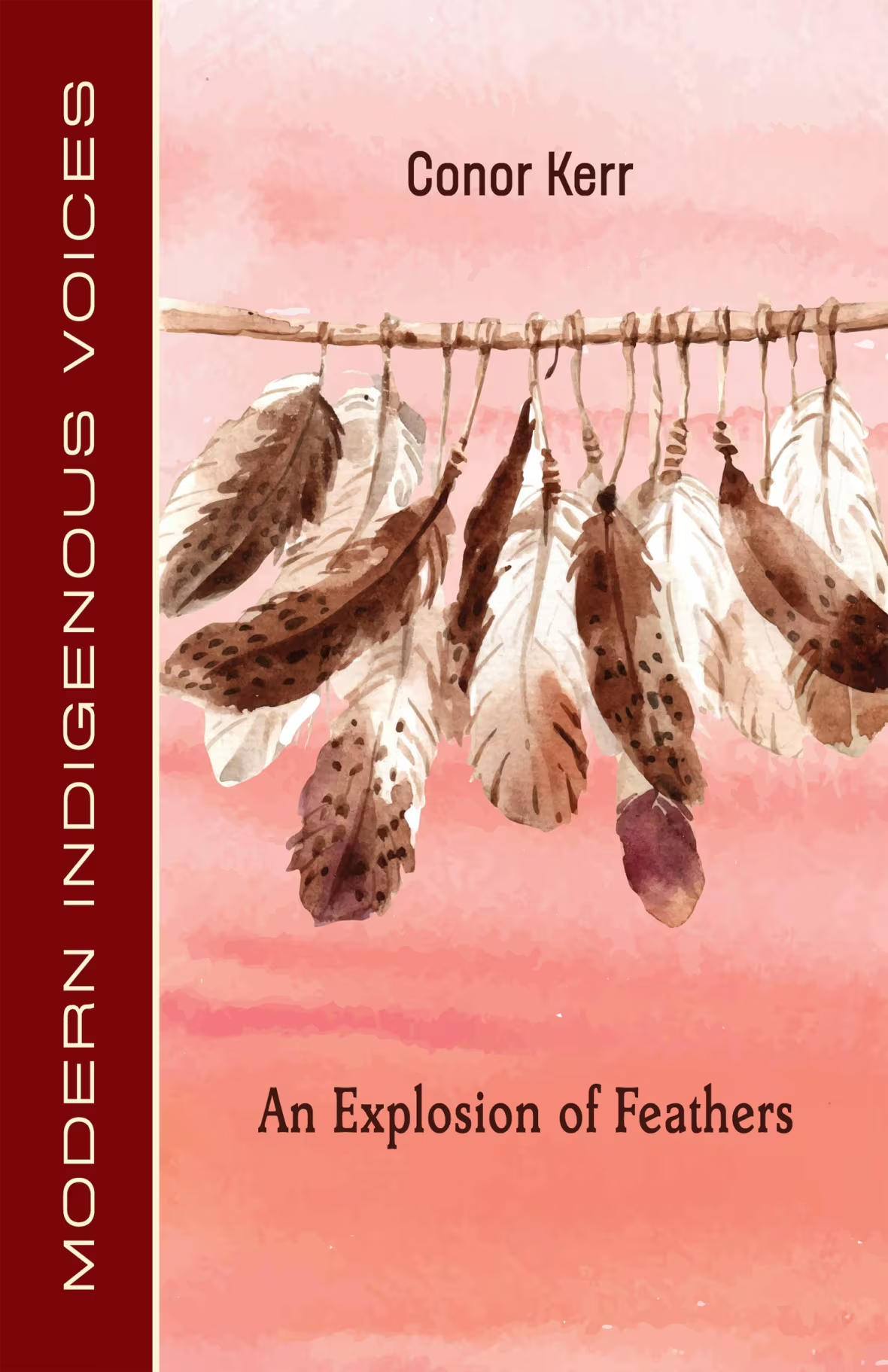
First, Conor Kerr’s An Explosion of Feathers (2021), which feels like such a tightly curated collection that even if you’re not as comfortable reading poetry as you are reading prose, there’s a place for you here.
The last section, for instance, begins with a poem about a young poet who has turned to writing for a way out of his basement apartment called “It’s All Magpies” and, then, nine poems titled like this: “A Magpie/Métis Boy Fights a Blue Jay” (which is actually more sports-related than you might guess) and “A Magpie/Métis Boy Visits A&W” (which includes a Celine Dion reference).
These are ordinary, relatable scenes presented with a vivid and tender sensibility. I love the ending of “Eating Macaroni Soup”, which reminded me of ideas I first encountered in Thomas King’s fiction: “Listening to the stories of our ancestors. The real stories. / Not the media ones.” And fits beautifully with the last stanza of “Abandoned Southside”:
Because I didn’t know yet that being Métis is creating
Your own narrative around the history of your walks.
That under the bridge, the campfires of your Granny’s
Family still burn, if you shut up you can still hear them
Singing long into the night, travelling songs, distinctive
Rhythms, that make a motherfucker want to get up and
Dance the long blocks back to the drudgy ass basement
Apartment behind the giant baseball bat.
(Aside: The baseball bat is on the Avenue of Champions which, coincidentally, is the title of Kerr’s first novel—which I reviewed for World Literature Today.)

Coincidentally, the family eats at A&W in Tauhou by Kōtuku Titihuia Nuttall [Te Ātiawa, Ngāti Tūwharetoa, WSÁNEĆ] too.
She reimagines a sense of belonging for a young woman, Māori and Coast Salish, who belongs on two different shores of the Pacific Ocean. I read it like a poetry collection, a couple of short chapters in a sitting. In this way, her vision of a future took shape so it felt as real as the characters’ memories of their pasts.
She’s careful, however, to explain in her Author’s Note that she’s writing out of her personal experience, not in any attempt to depict “the reality of the Indigenous people of Aotearoa and Turtle Island). But, she writes, the true elements in the book are the impact of colonization: “pollution, land neglect and abuse, domestic violence, the legacy of residential schools, urbanization, cultural and familial disenfranchisement, children in state care, suicide, and mental and physical illness.”
Her use of language is spare and evocative, its simplicity reads like authenticity rather than polish. I particularly enjoyed the way she handles a sense of time, the way it settles beneath her narrative like ink beneath skin.
“All evening Hinau looks at her wrists. When she washes her face before bed, she sees them in the mirror, the markings her whole family should have. She sees the thousand different women who made her, clenched between the tattoo’s teeth in ink and blood.”
Suzanne Keeptwo’s We All Go Back to the Land (2021) has a very conversational tone but a near-academic complexity. She deep-dives into the concept and reality of land acknowledgements (briefly: statements made to indicate awareness of inhabiting other people’s homelands) beginning with comments from other Indigenous individuals (some of whom retain anonymity because this is a politically charged topic) about these acknowledgements’ usefulness/inadequacies.
She clarifies that her decision to include polarised opinions is to encourage discussion; there’s no expectation of resolution or conclusion. She also confronts the divisions in Indigenous communities (she herself recognises both her Métis and Irish heritage), whether broader divisions (e.g. traditionalists and assimilationists) or more specific (Métis Nation and Métis peoples).
Ultimately, she views the land acknowledgement as a powerful concept that isn’t carefully or effectively utilised and she insists that cooperation and reconciliation can achieve positive results. (Thanks to Rebecca U. for this rec!)
“The Land Acknowledgement has the power and potential to be a unifier across nations and among peoples: First Nation, Inuit, Métis, settlers, and new Canadians. We have great writers, historians, academics, Knowledge Holders, Cultural Carriers, Elders, and youth. Let us find among them those who are also Great Orators. Let us, as Indigenous peoples, seek to train those, from within our respective communities, who demonstrate the innate gift to assume the role of the Great Orators of tomorrow. If approached, please embrace the Teaching of Bravery to fulfill such a role and entrust your community, urban or otherwise, to Stand You Up.”


Carleigh Baker’s Last Woman (2024) contains fifteen stories; it begins with “Midwives”, ends with the title story and, interspersed, contains a trio of “Billionaires” stories set in space. Baker’s Bad Endings was justifiably lauded and this new collection is equally accomplished. I really enjoyed knowing that, whenever I picked it up to read, I would feel that sense of “rightness” that one feels with a most excellently told story. If you caught that whiff-of-the-80s slang there, you will also love the vibe of this collection, which does feel entirely of-this-moment and, yet, includes an homage to the shopping mall. Several of the characters and stories inhabit that thin margin between wry laughter and edge-of-tears, which works because it all feels so believable, so natural. For me, Carleigh Baker’s stories live with Casey Plett’s, Shashi Bhat’s and Deborah Willis’: they feel so ordinary that you can imagine them being written on a napkin in a greasy spoon, except they are unexpectedly moving. [nêhiyaw âpihtawikosisân/Cree-Métis-European]
“This alpha who just came in is so beautiful the light sharpens around her like an Instagram filter. She’s definitely in a band, maybe two bands, and she’s her hairdresser’s favourite client. They go for Jack and Cokes on Fridays at a heavy metal bar on East Hastings. She wears a catsuit and a really long string of pearls, but everyone knows she’s metal enough to belong there. But it’s Saturday tonight, and she’s got a reading or a gallery opening later, so she’s dressed in the nineties-era uniform of the least popular boys in high school. Stonewashed jeans, tucked-in t-shirt, and a trench coat. She is owning it, though, because she’s that beautiful.”
“Alphas”
Cynthia Leitich Smith’s On a Wing and a Tear (2024) was an absolute joy to read. It’s a middle-grade story that hangs its hook on a widower grandfather who might reconnect with his high-school sweetheart, and Grandfather Bat who requires some wing repair just when his presence is required for a rematch of the legendary baseball game between the winged and the pawed. This is probably the first time that I have ever paused to share a scene from a middle-grade novel with Mr BIP because it made me giggle so hard. (Thanks to Gray Squirrel for the shenanigans!) The story actually resides with Mel, who is bookish and unsure where she belongs (because heritage-wise she has three types of ancestry), but all the characters on the roadtrip are relatable and simply doing their best to move through the world doing more good than harm. It was EXACTLY the kind of book I needed to read right now, and it’s made a fan out of me for sure. [Muscogee Creek Nation]
“Forcing a good-sport smile, Mel didn’t care if it made her an uptight city Native; she’d had a taste of the high life and the Wallace State Park campground wasn’t it. Then again, as her fingers curled around the fishing rod, she found herself longing for catfish for dinner, so maybe she wasn’t so citified after all.”


Bead Talk (2024) was exactly what I was hoping it would be. Glossy-paged with pictures of beaded artwork and women who bead: enough specialisation to feel the presence of expertise, but not so much that I feel excluded. I also love the idea that Brenda MacDougall expresses in the Foreword: despite her suspicions of online communities, she joined some during the pandemic lockdown, and the beading community sparked her to broaden her understanding of kiyokewin (visiting) and the ways we “create, reinforce, and maintain wahkotowin” (kinship). And what a lovely surprise to find conversations, as well as essays. Anyone who enjoys reading about creative pursuits will appreciate these. Marcy Friesen talks about how she can’t ever make an identical piece. Felicia Gay and Carmen Robertson talk about the importance of the kitchen table (among other elements) in Ruth Cuthand’s Boil Water Advisory #1 (with its tiny beaded swimming in glasses). Curious? Here’s a link to the beautiful scene of Katherine Boyer’s “The Grieving Bag” (2023)—zoom in, to see the detail in the beaded breeze.
Subtitle: Indigenous Knowledge and Aesthetics from the Flatlands
Editors: Carmen L. Robertson [Scots-Lakota], Judy Anderson [Nêhiyaw/Cree from Gordon First Nation, Saskatchewan], and Katherine Boyer [Métis])
More in a couple days but, meanwhile, which of these would you read first?
You’ve totally made me want to read On a Wing and A Tear! And I love the cover of Last Woman. I still haven’t read any of Carleigh Baker’s work.
I’m sure you will LOVE it. I assume it would have to be an ILL, but I hope you can get it in the summer…it’s just a great summer story! (You should have had it while camping!)
Not scary enough for camping. *snort*
Oh, you’re talking tough now, but I know… hee hee
What a wonderful collection of the reading you’ve been doing. Love the “Grieving Bag” the work is equisite!
Isn’t it? So vibrant!
I was curious about the Carleigh Baker book, although I never ended up requesting it when it was pitched to me. I still don’t gravitate towards short stories. We All Go Back to the Land sounded so familiar to me. I think I may have requested it, had it on my shelf for awhile, and then passed it onto someone else. Do you ever have that, where you can recall holding a book in your hand, but not reading it? I couldn’t find it on my goodreads tracker, so I’m quite sure I didn’t end up reading it…
There are a few requests lingering for me right now that I really WANT to accept but I know I don’t have the right time for them: we can’t accept everything and miss a lot of good stuff along the way, eh? Maybe the title is similar, or the cover illustration? Especially now that stock photos and images are standard, I feel like it’s so much easier to sense something is familiar but be unable to place the exact circumstances. It’s a very chunky little volume though, I’m sure your big-book radar would have gone off and warned you to keep your distance. hee hee (Which I completely relate to–as you know, but JIC someelse is reading this and misinterprets my comment as shady–I couldn’t read anything longer than 300 pages when the kids were small!)
I seem to have fallen out of reading Indigenous Lit. – Australian and North American. I didn’t mean to! We have Talaga’s The Knowing in our near future, but I’d better also read something closer to home.
These all have great covers, says she superficially! Probably, on the face of it, the one that most appeals to me is Carleigh Baker’s because I like short stories.
I’m interested in We all go back to the land, but I just couldn’t commit to a whole book on it. As Andrew says it’s a controversial issue here at the moment – particularly during the recent election. It can become formulaic rather than meaningful, but in one sense that could suggest it’s become embedded in our way of thinking and that is a good thing. In another sense, it means it’s just trotted out with no thought. There is no easy answer. One issue here is that there is still confusion in many people’s minds about “Welcome to country” (which can only be given by those on whose country you are) and “Acknowledgement of country” (which is given by those standing on country not there own.) As over there, there are mixed feelings here about it all throughout all levels of our community – including First Nations – but that’s not a bad thing because any conversation is better than no conversation. The challenge, often, is HOW to have the conversation!
It’s true thouogh: they are all great covers!
That’s an excellent point. There is an effort made, here, to have the speaker of an acknowledgement be Indigenous, but that is complex as well, because Toronto (Tkaronto) is an area through which many Indigenous peoples regularly travelled because of the waterways nearby. So that [choosing one speaker] can be seen as a decision which highlights the claim of one nation to that territory and seems to prioritise it over other nations’ claims/ties.
I was determined to read it through because a reading friend had specifically recommended it, but I admit that, in the beginning, I was unsure; what you can’t tell from the cover image is that it’s quite a chunky volume! But although I did have to read it fairly slowly, it wasn’t a chore; such a variety of ideas and experiences are shared along the way, that it feels like the scope is more far-reaching than the title suggess. And as comments here reveal, just talking about having the conversation takes some time!
I don’t think I’ve come across any of these writers or their books before, but they all seem to have something interesting to offer. A little like Madame Bibi, I know someone who would enjoy Bead Talk, so I’m made a note. It looks ideal for gifting…
We All Go Back to the Land sounds very interesting. I’m familiar with land acknowledgements mostly from Australia, both because of my travels there and because I do freelance work for an Australian company, and every online meeting begins with an acknowledgement of the traditional custodians of the land where the meeting is being hosted.
At first I viewed it as very progressive, having lived in the USA where Indigenous land claims were simply obliterated. But I also see the limitations – they can become no more than a ritual or pro forma statement, and if Indigenous rights are not respected in practice, then what difference does a statement by white people in a meeting make? So I have mixed feelings, and would love to read more about it from an Indigenous perspective. Interesting that it’s such a controversial issue that some writers chose to preserve anonymity.
There are mixed feelings throughout this volume, so I think you would enjoy the nuance. (But it doesn’t look like there’s an epub for this one.) It has become a very thorny issue. They can be educational, they can be upsetting. They can be reconcilitory, they can be polarising.
There must still be communities engaged in ongoing acts of resistance, maintaining their stewardship roles over the land in the United States, but we aren’t often hearing about them internationally. The most recent instance I can think of was maybe three years ago, in response to the pipeline in (what’s today) the northwestern United States. There is not a lot of media coverage of this in Canada either, and usually you have to make some extra effort to remain informed, so I figure it’s the same south of the (present-day U.S./Canada) border, but that it doesn’t mean it’s not happening.
My mother would absolutely love Bead Talk and I just searched, not really thinking I’d be able to get it here. But I can! So I’m off to spend some money, and thank you very much for alerting me to it 🙂
That’s amazing: I hope she loves it! Seeing a museum exhibit years ago piqued my interest (as an admirer, not a crafter).