
When I requested Dear Writer, Dear Actress, a collection of letters exchanged between Anton Chekov and Olga Knipper, I expected them to arrive when Bill and Bron and I were reading “Gooseberries”. (Our project page is here.)
If they had, my note-taking would have revolved around connections with their friendship and courtship, which began in 1899, and the love affairs in “The Darling” (1899).
But the love letters arrived at the end of July, when I was thinking more about Tolstoy than Chekov, so the TICHN were all the references to Tolstoy. (If you’re interested, and you can read on-screen, they’re available on the Internet Archive.)
And in the course of reading these, I also found this article about the time that Chekov and Tolstoy went swimming on August 8, 1895, the day they met and ate gooseberries (ok, they didn’t eat berries, but they did swim together—or, maybe they didn’t).


Knipper’s letters are filled with talk of her rehearsals and performances, so it fits when she mentions that Tolstoy attended “Lonely People” (by Hauptmann?) in February 1900: “He liked it very much and said the women were better than the men.”
The following autumn, Tolstoy visits Knipper in Moscow with a friend, and she writes to Chekhov about how Gorki had apparently read Chekov’s “story, In the Ravine, to some peasants and the impression it made. He kept moving about and shed a few tears as he remembered. And the peasants looked at your photograph with such curiosity and affection, and listened so attentively to his reading.”
She writes to Chekov months later, to say she’s worried about rumours of Tolstoy’s death, but Chekov replies to say there’s been “no noticeable change in his condition and he quite clearly has a long time to live”. He adds that future communications about Tolstoy’s health will refer to a grandfather, so that their communications are not disrupted. Around the same time, Chekov refers to the photo that Countess Tolstoy took of her husband and Chekov together, but warns Knipper that, if he’s able to send a copy, she must not make any other copies of it.
It’s hard to get a sense of how much disapproval and censure artists faced at this time in Russia, just from these letters. They are lightly annotated (edited by Jean Benedetti) but not indexed, and likely would be more rewarding if I knew more about these writers or about Russian history (or both). They’re pulled from a two-volume set of Knipper’s correspondence now out-of-print, and a 13-volume set of Chekov’s (with some excerpts from Knipper’s Memoir in between some letters).
But even so, the letters were mostly quite enjoyable. The pair’s growing attachment is moving, with increasingly tender sign-offs (so much hand holding, and later kisses). Their pet names arise much later (he calls her horseykins sometimes), and each is concerned about the other’s health. They refer often to their respective work, and the dedication of each is evident. Though, in 1901, Chekov quips: “I’ve given up literature altogether, and, when I marry you, I’ll make you give up the theatre and we’ll live together like planters. Would you like that?”

Knipper worries when Chekov goes out to eat too often (whether because she’s worried about rich foods or drink, or maybe about his catching a cold, as his tubercular condition limits his presence in Moscow and he must bundle up in furs there). Chekov worries when she misses rehearsals and, when later in their relationship she has a miscarriage, he is solicitous and writes even more frequently. (There are excerpts from Knipper’s memoir here, but Benedetti clarifies that Knipper did not record her miscarriage in her memoir.)
Letters are delivered irregularly and seem infrequent at times; there are a lot of complaints about their being too short and, in the beginning, Knipper worried that she wrote about dull and monotonous things (Chekov instructed her to write more of those things, he was always happy to have a letter from her). They still seem very much in love when Chekov dies in 1905. This part of the book is very sad, even though the letters are limited and short (because they are actually together by then), but not as sad as the final segment, which includes the letters that Knipper writes to him after his death.
When I finally read “Alyosha”, I noticed that Saunders quotes Gorky’s Reminiscences of Leo Nikolaevich Tolstoy, including a story about walking down the street with theater director Leopold Sulerzhitsky (the friend who visited Knipper with Tolstoy and Gorki, with the peasants so impressed with Chekov’s story).
It’s clear that just a little more reading around these stories would lead to greater appreciation and understanding.
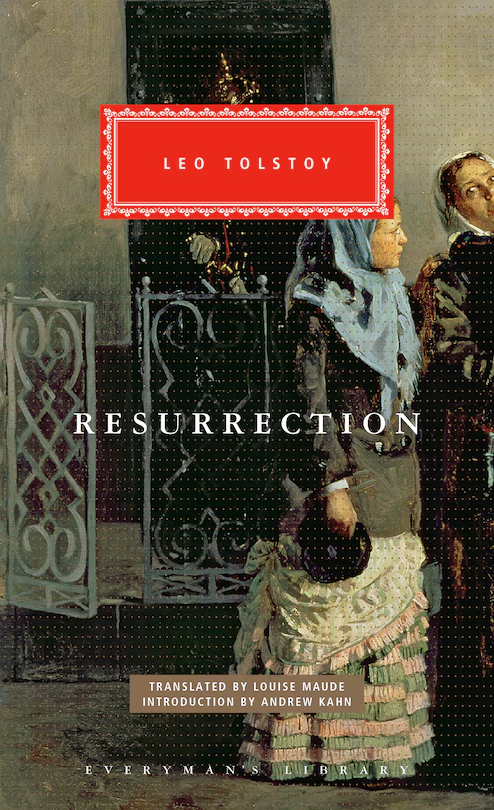
Saunders’ Afterthoughts for this story reinforce this thought, with not only a reference to Tolstoy’s Resurrection—which serves as a lens through which to imagine Tolstoy’s intent with Alyosha’s character sketch—but consideration as to how every decision that each translator makes underscores a different layer in the relationship between reader and story. (Saunders also refers to the work of three Russian-speaking friends and their comments on word selection in certain translation passages.) There is more to all of this, Saunders says (without saying): you need only look.
And, in a way I also was “reading around” with Anne Applebaum’s Autocracy Inc. (2024), which references political change in Russia/the U.S.S.R. throughout the twentieth century. It contains brief but valuable information about power politics which lurk in the background of these stories, which I found interesting. But what resonated most, for me, was her discussion of the playwright Vaclav Havel’s 1978 essay “The Power of the Powerless” and the importance of “small, symbolic acts of bravery”.
Through Havel, Applebaum reminds us that autocracies cannot be defeated at the ballot box or on the battlefield or in the public square, because autocracies have inexhaustible resources compared to ordinary people. But ordinary people have ideas and stories. Autocrats have “an enormous incentive to spread that hopelessness and cynicism, not only in their own countries, but around the world.” Which implies that hope and realism/optimism are essential to counter that inexhaustible (e.g. “flood the zone”) onslaught.


In this context, the moments of joy (or pleasure or contentment) in the stories Saunders has chosen—a woman reminded of a time when she felt like she belonged when she glimpses the light a certain way as a train passes, or a recognition of moment of beauty and contentment in a swim or freshly laundered linens—these come to mean everything.
These moments can symbolise a kind of freedom, an independent recognition of another set of values and priorities.
Ironically, Tolstoy ends his story “Alyosha” so that the overwhelming feeling is frustration and disappointment. Readers long for Alyosha to have resisted more, to have insisted on his own worth (of a new pair of boots, if only so that he can continue to work hard, of enjoyment of the cook’s company in the evenings).
But Tolstoy does give Alyosha a couple of moments of amazement. It’s up to readers to imagine what these might be, which is perhaps the broadest call to resist, of all these stories.
In short, if you don’t like how a story ends, create a different ending. In literature, yes, but in life too.
Saunders’ program is a lot of work, and I am still thinking about how his ASiaPitR works as a whole. Right now, I am a little sorry that it’s done, but I know that its impact on how I think about reading and writing will remain. And my TBR has lengthened considerably along the way.
Many thanks to my reading conspirators (as well as though who have read and commented, while busy reading other good books and stories): I would not have been half-so attentive without y’all.
Congrats on finishing the project! It’s been interesting to see the multiple layers of reading and interpretation going on, with me reading you reading Saunders reading Tolstoy etc., and then stepping back to read what Bill and Brona and others have to say about their reading of your reading of Saunders’s reading of Tolstoy. There’s a value in that really close reading, I think, of short stories that could otherwise be quite ephemeral, especially when they’re part of a collection and you tend to just roll from one to the next.
Thank you, it was a short one, compared to your Borges marathon. Heheh It’s been really surprising at times, seeing just how differently each of the three of us has responded to certain aspects of the stories and, as a result, how differently we have imagined the authors’ intentions. From a writer’s perspective, that’s been a little unsettling, TBH, because you are already aware that not everyone will respond to your story the same way, and you know not everyone has the same taste/inclinations, but you don’t (or, I don’t) imagine opposite opinions when everyone is reading closely and carefully. But, also, fascinating.
This seems like an achievement, the completion of this project. I don’t think I have the attention span for close, sustained focus/reading like this. Well done! I think about paper letters, which my friends and I used to write one another regularly in college, as a precious gift. I have one friend from college with whom I still write back and forth. I love that it still continues, all these years later. It makes me sad that historians in the future may not have letters between contemporary writers to study. The ephemeral nature of texts!
When I think about it for a moment, it seems as though stretching out a read like this, over several months, is foolish. But I don’t think I could have absorbed this more quickly. And I’m sure it’s why I couldn’t manage it as a library loan, when it was new. I often found myself dragging my index finger beneath Saunders’ questions and wresting my focus back a few sentences because my thoughts had wandered. But, for just a couple hours a month, that was manageable… enjoyable, even… as it unfolded. It’s how I felt with the Kendi book you’re reading now… like a student again!
The End, congratulations it’s been quite an education!
At the beginning of a reading project, it usually feels to me as though it’ll never end but, then, it does!
We basically ended up in the same spot with this story I think Marcie – https://bronasbooks.com/2025/08/18/alyosha-the-pot-leo-tolstory-shortstory/
I will let you and Bill nut out whether reading these stories with Saunders was a useful thing to do or not. The main thing I learnt (which I was kind of already doing in an unstructured way) was to read all short stories slowly, thoughtfully and deliberately. Contemplating what the author intended, the unintended meaning and what I thought about it all.
Thank you for hosting this Marcie – it has been a thought-provoking experience and I have enjoyed how we have spurred each other on and lit some sparks in our thinking over the seven months.
I neglected to mention I had some holidays planned shortly after posting about this story, so I’m slowly catching up now and will soon read your thoughts and Bill’s on the last story. I think I’ll write up the Saunders book for my writing site, and try to think about it from that perspective for a change, but I’ll have to see if I took the right kind of notes for that.
It’s been such a pleasure sharing these stories with you and Bill: I’m looking forward to other potential overlaps in our reading plans/interests.
I regret not joining in with this this summer, but then I also knew I would fall behind. But I’ve been enjoying reading your posts–and following your reading around. The Knipper-Chekhov letters sound just fascinating.
My copy came via TPL… but it’s back on the shelf now! And I know what you mean, choosing one book means not choosing another. Over the summer, I also read Hohl’s The Notes (which I believe you rec’d?) but I barely got to finish reading it, let alone write/share about doing so. #choices
I did read The Notes in February/March, but didn’t actually write anything about it either and without your excuse–I had no trouble renewing at that point. I did copy out a bunch of the aphorisms, though. What did you think?
I just loved the idea of it, and it left me longing for more volumes like it, curated with the same dedication and focus. But, then, I’ve just gone to look for my notes, and I can’t find them. There was a lot of nodding and hmmmming, y’know? That kind of book?
I was twigged to it by reading a book of aphorisms by Canetti–I had half a post on writers of aphorisms but it never came together. It’s a weird genre I tend to like.
I’m sorry I never read all of your installments on this project, but awesome work, it seemed like a big one! Russian literature is something I’ve read so little of, I think I find it a bit intimidating actually. That being said, memoirs, letters to one another, and of course fiction are a wonderful way to break through this anxiety!
I suppose I didn’t think about it long enough to get intimidated by it, and then the stories themselves are quite straight forward actually. But thinking about it now, how could it not be a LOT, thinking about starting into another country’s entire literary history. Think of CanLit. It’s a lot. Then think of how much longer Russians have been writing down their stories. heheh
Congratulations on completing this project! It’s been so interesting to hear your thoughts throughout.
Thanks, it was something of a relief to make it to the other side but, then, I have found myself gathering more Russian reads, so, um… well, you know how it goes…
I might remind Anne ” autocracies cannot be defeated” Applebaum of the successful French, American, Russian, Chinese and Cuban Revolutions – about half the world’s population wouldn’t you say? Nevertheless, I do believe in the power of “small, symbolic acts of bravery”, not least by writers.
I was interested in Saunders’ deconstruction of the stories, and hopefully I learned something. But he did nothing to persuade me that these were representative of the world’s best short stories, I’m not sure he even attempted to explain why they might be, nor why they might be important in the context(s) in which they were written.
I probably did a disservice in trying to summarize her ideas, but I don’t think she’s trying to say that revolutions don’t work, only that autocracies themselves (as opposed to the kinds of governments in those countries you’ve mentioned) require a different kind of resistance (maybe because of the cross-national support of autocratic leaders, which would be another layer in the foundation of their power).
That wasn’t his intention, I don’t think: at some point, doesn’t he even say that it was a rather random choice, that they were simply amongst those he had reread most often and had spent more time contemplating?