
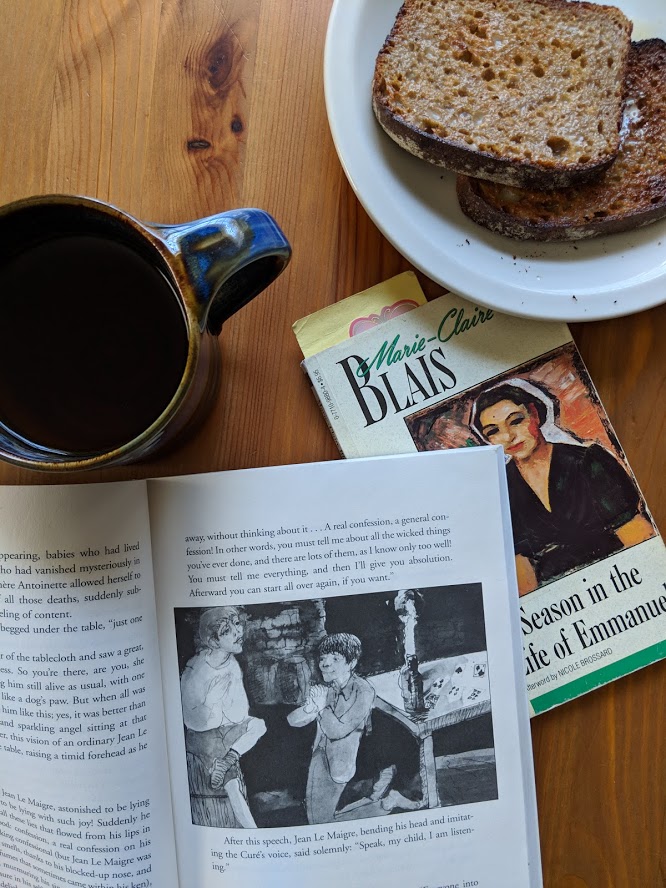
Marie-Claire Blais, Reading for the #1965Club

2019-04-29T09:17:10-04:00

If you are reading this post because you are part of the #1965Club, and you haven’t heard of Marie-Claire Blais, you are about to wonder how that can be true. (And if you also haven't heard of #1965Club, please visit Karen's and Simon's sites to learn more.)  Blais has published

Marie-Claire Blais, Reading for the #1965Club2019-04-29T09:17:10-04:00

Mavis Gallant’s “Orphans’ Progress” (1965)

2019-03-05T17:42:12-05:00

Language is important in “Orphans’ Progress”, specifically the relationship between English-speakers in Ontario and French-speakers in Quebec (predominantly Montreal, with a reference to Chicoutimi). It matters, immediately and lastingly, because the orphans, Cathie and Mildred, are the children of an English-Canadian man and a French-Canadian woman. Governor General's Award Winner

Mavis Gallant’s “Orphans’ Progress” (1965)2019-03-05T17:42:12-05:00

February 2019, In My Reading Log

2019-02-08T11:58:51-05:00

In which I discuss recent reading which deserves particular attention: two novels, spanning an African immigrant’s contemporary experience in London and a trio of English sisters’ experience of the interwar years, and a graphic memoir spanning a young boy’s experiences in Syria, France and Libya. In Harare North (2009), Brian

February 2019, In My Reading Log2019-02-08T11:58:51-05:00

Mazo de la Roche’s Finch’s Fortune (1955)

2024-07-19T11:08:33-04:00

“With her book, her roses and her cake she was separated from the other members of the family in a kind of frosty seclusion.” Alayne’s frosty seclusion doesn’t sound all that bad, does it? But the point is that Alayne feels her separateness. And that's not always comfortable. Nor

Mazo de la Roche’s Finch’s Fortune (1955)2024-07-19T11:08:33-04:00
Go to Top