Over the weekend, I started to pull Summer Reading options from various bookcases. I’d been wondering aloud, last week, about how to mark the distinction between spring and summer. The fledgling stack is an excellent reminder that I should write about my spring reading now, while the scent of the lilacs wafts in the front windows, and the scent of the lilies of the valley wafts through the back windows. (Besides my accidental spring reading, that is.)
My spring reading began with “Gold Watch”, a short story by John McGahern: “It was in Grafton Street we met, aimlessly strolling on one of the lazy lovely Saturday mornings in spring, the week of work over, the weekend still as fresh as the bunch of anemones that seemed the only purchase in her cane shopping basket.”
I pulled The Penguin Book of Irish Short Stories off my shelf in March, remembering Irish Short Story Month which Mel @rereadinglives first celebrated in 2010. After a few years, he got bit hard by the Irish-writing bug and the event stretched into the summer to make room for more interviews and reviews, and soon it seemed like a condition rather than an event.
It was 2014 when Mel posted about McGahern, but I didn’t get serious about him until this year (his Collected Stories just arrived, from overseas, last month).
It was snowing, it didn’t feel like spring outdoors yet, but it felt as though McGahern’s story was speaking directly to me. With this young man and young woman, who had graduated from the same law class five years before, who reunite in a street and strike up a conversation.

The characters take shape slowly– tentatively and authentically—as time passes and an ease develops between them. Other relationships in their lives hover on the fringes, with a little more prominence afforded to his parents than to hers. “And yet you keep going back to the old place?” she asks him.
“It’s just easier for me to go back than to cut,” he replies. “That way I don’t feel any guilt. I don’t feel anything.”
My copy of this anthology is second-hand, well-read: its spine so worn that it no longer feels worn anywhere in particular, only all over the place. There are only a handful of notations throughout the whole 544 pages, left behind by a previous reader, but this reply from the young man is underlined.
Below, on the same page, the word ‘yew’ is circled and, at the bottom: “a graveyard tree”.
Earlier in a story by George Moore, there is a single question mark in one margin.
I don’t know which of these leaves me more curious.
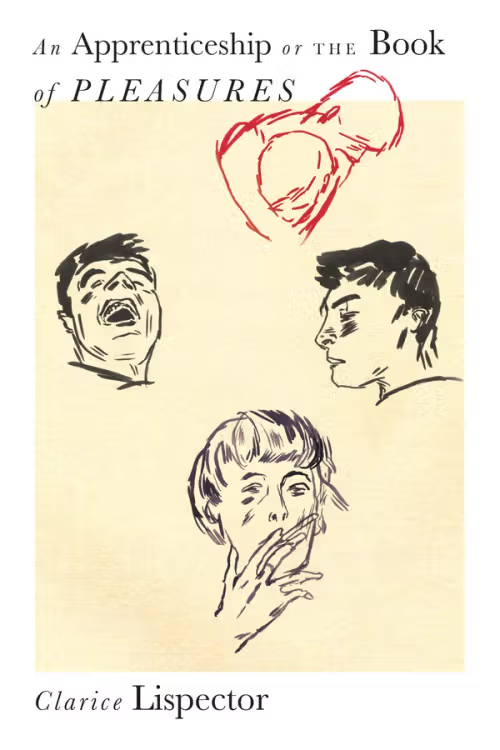
The same weekend, I began reading An Apprenticeship or the Book of Pleasures by Clarice Lispector (1969: Trans. Stefan Tobler, 2001).
It begins like this: THE ORIGIN OF SPRING OR THE NECESSARY DEATH IN THE MIDDLE OF THE DAY.
Perfect timing, I thought, but after about a dozen pages, I stalled.
When I returned to it, a couple weeks later, and not in the evening but, yes, in the middle of a weekend afternoon, I reread those pages and read it straight through.
Not comprehensively—only catching a hint of understanding every, ohIdunno, seventh sentence or so—but contentedly enough.
At the end is a short essay by Sheila Heti in which she says that she goes and finds herself a place where she can be alone with a work by Lispector: “I prefer to read her from start to finish, without interruption.”
It was comforting to find that Heti’s method of reading Lispector seems to align with mine (as she’s likely read more than I have).
It was also comforting to realise that the narrator was also confused and unmoored much of the time.
Opening the narrative in spring feels suitable, as the narrator seems to be moving towards something, perhaps blooming one could say.
But I also wondered about how her story would have played out if she had gone hunting for herself in the winter instead.
Must one begin a storm of love’s bloom in the spring? What of the growth that still lingers beneath the layers of snow that slowly and steadily accumulate, where beneath, insulated temporarily, one’s own sense of self can take root in that sheltered and slow-moving enclave.
I think we have become lazy, forgetting the root of a bloom; it makes us discount states of restoration and resilience and focus only on the shoots and leaves.
But Lispector’s story needs to end when the air is muggy and the smell of jasmine thickens the air at night, so this story must begin with spring.

I also reread Elizabeth von Arnim’s Enchanted April (1922). It’s an old favourite but, usually, I reread it when it is decidedly spring. Certainly at least April, and often so late in the month that plenty of flowers have already shot up in evidence.
This year I began reading when it was just as grey and miserable outside, as it is when Mrs. Arbuthnot and Mrs. Wilkins first meet on a rainy day in London, when they are both caught unawares by their desperate need for sunshine and wisteria blooms. It’s quite a different experience, reading it like this. Their sadness felt so pervasive, the heaviness of that wet day so burdensome.

Simply for the look of it, I chose one for its beautiful and intricate cover illustration which blooms against a vibrant green background, and it brought to mind spring, whenever it made its way to the top of my stacks: The Language of Languages by Ngũgĩ wa Thiong’o (published by Seagull Books in 2023).
It’s a collection of essays about language and culture, translation and storytelling: some only a few pages long, others more complex. If you have heard the news of his recent death, this lush volume could be an excellent introduction for you, if you’ve always meant to explore his work.
Summer is my least favourite season: I wonder if I can adjust my thinking on that, with just a bit of bookish concentration.
SPRING QUOTE
By Elaine Feeney“And though it was late, there was a stretch to the evening’s light, purple crocuses budding and tentative green shoots of daffodil heads poking through the ebony soil in some window pots.”
PS Of course I love Enchanted April!
I just listened to “The Good Read” episode from April which recommnds it (I absolutely LOVE this podcast) and was reminded of it all over again!
I’m intrigued by The language of languages because the whole issue of translation is so interesting, but I think I would probalby want to read some fiction first, like Weep not, child. Maybe I could get my reading group to read him. (BTW Mr Gums is currently reading Mansfield Park in two translations, each chapter in one translation and then the other. It’s slow going but he’s finding it interesting. Lest this make him sound awfully erudite about literature, he’s not. He just loves German and he really likes Jane Austen!)
I’d be interested in an Irish short story anthology but I have a couple of themed anthologies by my bedside now so that will have to do me!
I was just leafing through Weep Not Child the other day (Bill and I are planning to read it soon, if you can’t pique the interest of your bookgroup). I have a feeling it’s going to be one of those skinny books that is surprisingly dense. I was actually wondering if I mightn’t be better off reading one of his massive novels instead.
OH, what an interesting project. I suppose I could try it with reading different Proust translations. Hmmmm, you’ve got me spinning on this now. It would be very helpful in securing my French (I can read light fiction but can’t read the kind of fiction in French that I most love to read in English). My German is very basic; I’ve only had about a year.
You’ve been so dedicated to your anthology reading; I do love short stories but have mostly avoided anthologies until recent years. I’m beginning to understand the appeal.
Loved that spring quote! Lily of the Valley and Lilacs are my favourite, I have both in my garden here (although they typically don’t come out until early June here in Calgary) because they remind me of home in Ontario.
Annotations from other people in used books is such an interesting thing. I find myself puzzling over why the previous reader underlines or marks notes in the margins, which is a fun layer to my reading.
I chose it just for you: I know you love the flipbox quotes! lol
They feel like such “home” plants, I agree. The lilacs in the north are done now, but the lilies remain.
Sometimes I find them too distracting, but these are occasional and neatly inserted.
I do like Lispector, though I seem to be much better at collecting her books than actually reading them. Enchanted April is such a gentle, comforting book. I have to say spring is my least favorite season in spite of it being the beginning of gardening. It’s just so hectic and my allergies are worst in spring. I like mid-August to the end of October best 🙂
I can see where she would be a good candidate for collecting: so many lovely small presses have taken an interest. I started with her short stories (and I’m certain that’s not one of the volumes in your collection lol).
That’s leaf-mold season for me, heheh, but I agree that it’s usually crisp and beautiful that time of year: autumn used to be my favourite though.
Thanks for bringing Ngũgĩ wa Thiong’o’s Language of Languages to my attention. I’d heard of it before and have been trying to recall the title for years now.
I’ve had that happen myself, so I’m happy to hear my mention filled a gap in your memory!
Bill wrote a nice intro/farewell post about NWT’s recent passing here, if yo’ure interested, and there are a few links (some in the comments) to various remembrances about him and his work too.
I haven’t read or heard of any of these though appreciate you sharing! What makes summer your least favorite season? I’m not a fan of the heat though I’m curious for you if it’s climate-related or something else. Love that you captured the scent of lilies from the valley!
I’ve really been enjoying my seasonal reading this year–another way of … well… being more present, which feels like an overworked term these days, but, still. Much of it is physical, related to poor-air-quality from the forest fires that are raging for instance, and the sorrow that accompanies those crises, but I think I’ve always felt that summers should be a certain way, even as a kid, and they weren’t: as much as I hated school, I liked being able to go there (a September-to-June thing here).
Thanks for the heads up about The Language of Languages – it sounds very interesting. If I wish to keep to the seasons aligned, I have to reread Enchanted April in September or October 😀
If you don’t know Seagull Books, you are in for a treat. I know how you love the look of a “set” on your shelves: theirs line up beautifully.
Or it could be like a dash of new-growth when you’re in the middle of autumn? Or cool skies and falling leaves when things are starting to bloom?
Definitely feels like summer here! I have started a list of things I love about summer: fireflies in my backyard, long light evenings (till after 9 pm!), CHERRIES – my favorite fruit but only good a couple of months a year, popsicles, not having to bundle up, not having to get up quite so early since my son is out of school. That’s what I’ve got so far.
The Enchanted April is a book I’d like to reread someday. I just read it for the first time a few years ago. I keep meaning to get to more of her work.
Bill mentions Elizabeth and Her German Garden and, given you much you enjoy your flowers I bet you would enjoy that one quite a bit (it’s also quite slim).
You mention so many nice summer things. That’s a great idea: I’m going to make my own little list! Thanks, Laila.
I think I’d like the Ngugi collection. I read and enjoyed his Decolonising the Mind years ago, and it sounds as if this might cover similar territory but from a different angle, and probably with newer material. I didn’t know about it, so thanks for the alert! And yes, very beautiful cover – that’s more than you can say about Decolonising the Mind, which featured an odd photo of Ngugi’s forehead…
Oh dear, that doesn’t seem like a particularly welcomoing book-cover: was it intended to allude to all the thoughts swirling around in there? heh
This volume is probably much like the “readers” assigned to students and I’ve been appreciating those kinds of volumes more and more.
A lovely selection. I haven’t read Enchanted April for AGES!
I wonder if you’ve seen the film, as I had when it was new? I rewatched it with this reread and thought it just as charming.
You are reading some interesting books. This summary leaves me wanting to know more about them. I haven’t read much von Arnim, but I think I will try and get a copy of E and her German Garden and start from there.
That was my door into EvA, and I have reread it once (the follow-up is The Solitary Summer, IIRC) but somehow Enchanted April has become a surprisingly frequent reread. This is the first time I’ve read her since understanding her connection with Katherine Mansfield. I might try another for summer…
I’m going to read Enchanted April this summer, not so neat as reading in actual April but almost!
Actually…it might be perfect because I was thinking this time, as I read along, that things bloom there so much more quickly. The flowers I was reading about in later-April are all later-June flowers here. But EVA does have a “Summer” novel too, I believe?
I’m so glad you enjoyed the McGahern. While beautifully expressed, his early work can be quite dark as befits his own life but his novel That They Might Face the Rising Sun reads like the work of a man who has found peace.
Hmmm, I think that’s the one that I bought earlier this year, now that you mention it. I wonder if it’s the one Vishy read too. But with your advice, I’m thinking I might rather start with the “younger” authored works (once I venture beyond the stories). I have no single reason for it…but I have grouped him with William Maxwell in my mind?
Beautiful reviews! Loved hearing your thoughts on John McGahern’s story. I read one of his novels last year and loved it. It was my first McGahern. I’ll always wanted to read The Enchanted April. The cover of Ngũgĩ wa Thiong’o’s essay collection looks so beautiful. Thanks for sharing your thoughts
Thank you, I will try to remember to look back for your post when I get to reading his novels. (I have one, with the “new” Collected Stories, somewhere.)
I feel sure you will enjoy Enchanted April: it would be nice to keep it for a moment when you need something not-light-but-still-very-comforting.
You must be able to quite easily access Seagull Books’ publications? They are such lovely little hardcovers, I would find it hard to resist if I could see them all in person.